
Bioinformatics Is Moving Fast, But Are We Thinking?
Bioinformatics has been racing toward automation for the last 20 years. We develop larger databases, more advanced machine learning models, and faster pipelines every year. With a few lines of code, tasks like sequence alignment, genome annotation, and variant analysis that used to take months can now be finished in minutes. This appears to be progress on paper. And it is in a lot of ways. However, at some point, we may have mistaken speed for understanding. The majority of computational systems used in biology today are made to automate tasks rather than think about them. Sequences are processed, structures are predicted, variants are categorized, and probabilities are produced. However, biology does not function like a classification algorithm or a spreadsheet. Living systems are complex, context-dependent, and have evolved in ways that frequently defy straightforward patterns.
Agentic AI introduces a different paradigm. Instead of static pipelines, agentic systems can plan, reason, verify, and iterate across multiple biological data sources much like a human researcher. Rather than simply producing outputs, these systems can generate hypotheses and refine conclusions based on biological context. This shift from automation to biological reasoning represents the next evolution of bioinformatics.
The Automation Trap VS Agentic Intelligence
Simplified models of reality, assumptions, and training data are all important components of algorithms. These systems execute tasks efficiently but rarely evaluate whether their predictions make biological sense.
Algorithms perform well in standard scenarios but struggle in rare biological contexts. Predicting the impact of a mutation, for example, is not just a classification problem. The effect of a mutation depends on protein folding, cellular environment, gene regulation, epigenetics, and sometimes completely unknown interactions. Automation processes the data. Biology lives in the exceptions.
Agentic AI systems, however, can actively question predictions. If a mutation is predicted as deleterious, an agentic system can automatically investigate structural effects, evolutionary conservation, pathway involvement, and interaction networks before reaching a conclusion.
Example: Mutation Interpretation Automation vs Agentic AI
Traditional Automation Pipeline
Variant → SIFT → PolyPhen → CADD → Final Prediction
Output:
- SIFT: Deleterious
- PolyPhen: Probably Damaging
- CADD: High Score
Conclusion:
Mutation is harmful. However, this conclusion may be incomplete.
Agentic AI Reasoning Pipeline
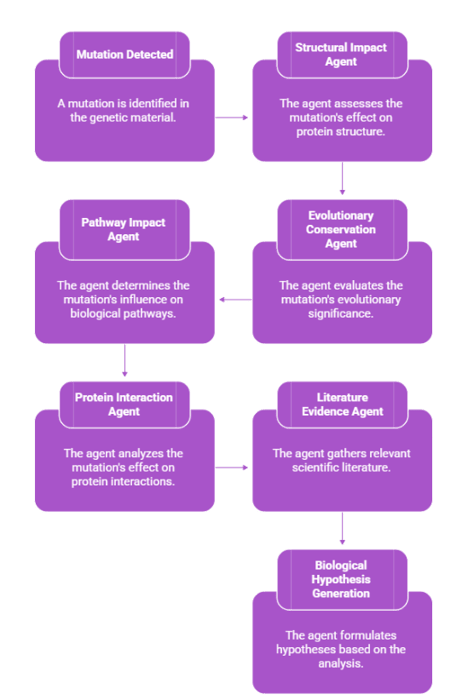
Final Output:
"Mutation likely disrupts protein folding, affects immune pathway, and is conserved across mammals high biological significance."
This transforms prediction into biological reasoning.
What Agentic AI in Bioinformatics Looks Like
Imagine a bioinformatics system that behaves like a research assistant:
- One agent performs variant calling
- Another agent evaluates mutation impact
- A third agent checks pathway involvement
- A fourth agent validates literature evidence
- A fifth agent integrates findings
Instead of static pipelines, this multi-agent architecture enables dynamic reasoning and hypothesis generation.
Such agentic systems could significantly accelerate biological discovery while maintaining biological accuracy.
Example: Drug Target Discovery
Traditional Automation
Differential Expression → Pathway Enrichment → Target Selection
Agentic AI Approach
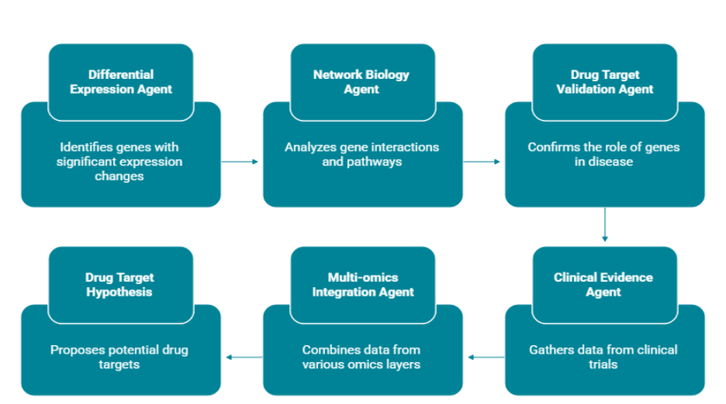
Final Output:
Gene X is upregulated, interacts with immune pathway, and has existing drug compounds strong therapeutic candidate."
A New Vision for Bioinformatics
Automation will always remain essential. The volume of biological data is too large for manual analysis. However, automation should handle repetitive computation while agentic system assists in biological reasoning.
The future of bioinformatics lies in agentic AI systems that reason biologically rather than automate blindly. These systems will not simply process data they will generate hypotheses, questions assumptions, and integrate biological knowledge across multiple levels. Biology is not just data. It is a system shaped by billions of years of evaluation, full of exceptions, adaptions and unexpected patterns. To truly understand life, bioinformatics must move from automation to agentic intelligence.