

“It’s easy for AI to sound like a doctor but the challenge is getting it to think like one.”
Walk into a modern hospital today, and you may not notice it but ai is already working.
Generative AI is transforming healthcare rapidly. From summarizing patient records to assisting diagnostics, systems today can produce outputs that feel intelligent and clinically meaningful. However, in healthcare, sounding correct is not enough, systems must be reliable, explainable, and trustworthy.
A response that is merely plausible can still be dangerously incorrect. And when decisions impact human lives, that gap between impressive and trustworthy becomes critical.
This is where the real story of generative AI begins, not just its evolution, but the challenge of making it reliable.
From Rules to Reasoning: How AI Evolved
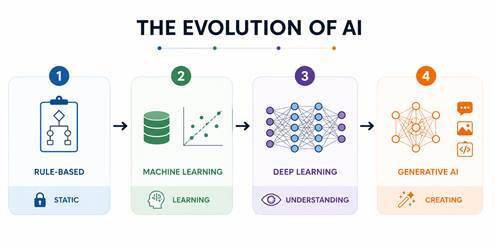
AI didn’t suddenly become powerful. AI has evolved through multiple stages:
- Rule-based systems: Firstly, AI relied on fixed rules written by experts. These systems were predictable but rigid. They couldn’t adapt or learn.
- machine learning: AI began learning from data instead of rules. This improved flexibility but still required heavy manual effort to define features.
- deep learning: Neural networks changed the game by automatically identifying complex patterns especially in images, speech, and text.
- generative AI: With the rise of transformer architectures, AI moved beyond predictions.it started generating human-like responses with context and coherence.
This shift represents a move from rigid logic to systems capable of simulating reasoning and generating contextual responses.
The Transformer Breakthrough
The real turning point came with the introduction of transformer architecture.
Unlike earlier models that processed information step-by-step, transformers could analyze entire sequence at once using attention mechanism. Transformer architecture enabled models to understand context rather than just keywords.
The result?
- AI that understands context-not just keywords.
- Responses that are coherent across long conversations.
- The foundation for the modern large language models.
This led to modern systems capable of coherent long-form responses and real-world applications like healthcare decision support.
Scaling Laws: Bigger models, bigger capabilities
One of the most surprising discoveries in AI research was this:
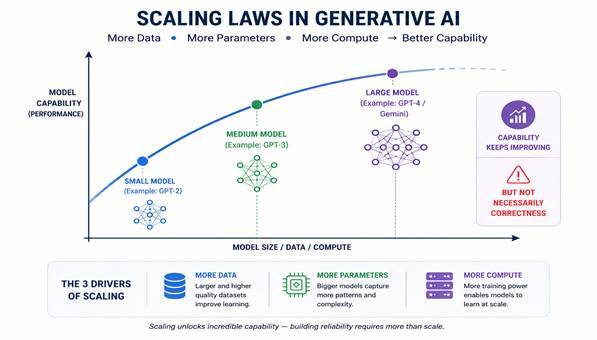
If you know as scaling laws led to the creation of massive models trained on enormous datasets.
These models can:
- Answer complex medical questions.
- Generate structured reports.
- Assist in multi-step reasoning.
Scaling made models more fluent and powerful, but it did not guarantee correctness, especially in high-stakes domains like healthcare.
Increasing data, parameters, and compute improves model performance. However, while capability increases, correctness does not always improve creating a gap between intelligence and reliability.
The Reliability Gap
Despite their capabilities, generative ai systems have fundaments limitations:
They can:
- Hallucinations: Produce confident but incorrect answers.
- Struggle to explain how they reached a conclusion.
- Reflect biases from training data.
- Generate inconsistent outputs for the same input.
What makes this dangerous is not the errors. But how convincingly they are presented. These issues become critical in healthcare where errors can directly impact patient outcomes. This is not a flaw in implementation it is structural characteristics of how these models are trained.
Why Healthcare Is Different
Healthcare requires high accuracy, strict regulation, explainability, and real-time decision-making. AI must be trustworthy, not just helpful.
AI systems here must meet requirements such as:
- Patient Safety-Errors can be life threatening.
- Regulatory compliance: must meet strict legal frameworks.
- Explainability: Doctors need to justify decisions.
- Real-time accuracy:
- Delays or approximations are unacceptable.
In most industries ai needs to be helpful. But in healthcare it needs to most trustworthy.
From Models to Systems
The future of healthcare AI is not about building a single powerful model.
It's about building reliable systems around it.
Reliable healthcare AI requires layered systems:
- data layer: verified medical data sources.
- retrieval layer (RAG): fetching accurate, real-time information.
- reasoning models: AI processing and analysis.
- Guardrails: safety checks and validations.
- Human-in-loop: clinicians reviewing outputs.
Human-in-the-Loop
AI should augment clinicians, not replace them. Human validation ensures safety, ethical judgment, and accountability.
Doctors bring:
- Experience
- Ethical judgment
- Contextual understanding
AI brings:
- Speed
- Data processing
- Pattern recognition
The strongest systems combine both.
Human-in-loop design ensure:
- AI suggestions are validated
- Errors are caught before impact
- Trust is maintained
Real-World Applications: Potential vs Challenges
1. Medical Imaging: Google DeepMind
Potential: High accuracy in detecting diseases from scans, faster diagnosis
Challenge: Works best on structured data; struggles with rare cases and lacks explainability
2. Clinical Decision Support: IBM Watson Health
Potential: Assists doctors with data-driven treatment suggestions
Challenge: Difficulty in real-world context, low trust, and workflow integration issues
3. Drug Discovery: Insilico Medicine, DeepMind AlphaFold
Potential: Speeds up drug development and molecular research
Challenge: Requires extensive human validation and strict regulatory approval
Conclusion
Generative AI has come a long way from rigid rule-based systems to models that can reason, respond, and assist in ways that once felt impossible.
But in healthcare, progress isn’t judged by how intelligent a system appears. It’s judged by something far more critical.
- Safety - Does it protect patients?
- Reliability - Does it work consistently, even in complex situations?
- Trust -Can clinicians depend on it when it matters most?
The future of healthcare AI won’t be built around a single powerful model working alone. It will be shaped by thoughtfully designed systems, where AI supports clinicians, safeguards are built in, and every output is accountable.
Because at the end of the day, in healthcare, one truth stands firm:
Being impressive isn’t enough. Being trustworthy is everything.
The future of healthcare AI lies in building reliable systems, not just powerful models. Trust, safety, and validation will define success.