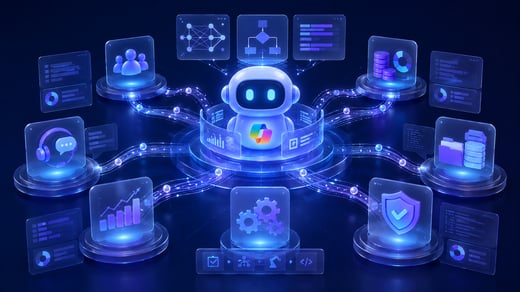

Every week, another enterprise announces an AI deployment. And every week, quietly, some of those deployments fail, not because the AI wasn't smart enough, but because it was too unpredictable to trust. A customer gets a confidently wrong answer. A workflow skips a compliance check. A decision is made without the right authorization. The problem isn't Generative AI itself; it's deploying it alone, without guardrails. That's where Hybrid AI Agents come in.
Why Hybrid AI?
Enterprise AI systems often struggle to balance flexibility and control. While LLMs excel at understanding natural language and handling unstructured inputs, they cannot always guarantee accuracy or compliance with business rules. Traditional rule-based systems provide consistency and governance but lack adaptability. Hybrid AI agents combine these strengths, enabling organizations to build systems that are both intelligent and reliable.
In many enterprise scenarios, reliability matters more than creativity, making hybrid architectures a more practical choice than purely generative systems.
Architecture of Hybrid AI Agents
Building a hybrid AI agent requires a modular and well-structured architecture. Unlike traditional chatbots, these systems are designed as a combination of multiple layers, each responsible for a specific function.
1. Perception Layer (Interface)
This is the entry point where users interact with the system. It can accept inputs in multiple formats such as text, voice, or images. The primary role of this layer is to process and standardize user input so it can be effectively understood by the system.
2. Cognitive Orchestrator (Reasoning Engine)
At the core of the system is the orchestrator, typically powered by a Large Language Model like GPT-4o or Llama 3. Instead of directly generating responses, it acts as a decision-maker by:
- Breaking down user requests into smaller tasks
- Identifying the right tools or components to handle each task
- Planning the sequence of execution
In enterprise environments, the orchestrator acts as the coordination layer between the LLM, business rules, APIs, and external systems. It ensures that tasks are executed in the correct sequence, routes requests to the appropriate tools, and maintains traceability throughout the workflow.
3. Symbolic / Deterministic Layer
This layer ensures reliability and accuracy, which is critical for enterprise use cases. By handling logic and validation here, the system avoids relying entirely on probabilistic outputs. It includes:
- Rule engines for enforcing business logic
- Knowledge graphs for structured and factual data retrieval
- Computation modules for precise calculations
This layer enables the system to perform real-world actions. Through API integrations, the agent can:
- Fetch live data
- Interact with external systems
- Execute tasks such as sending emails or updating databases
5. Memory Layer
Enterprise AI applications often require context beyond a single interaction. The memory layer stores relevant user information, conversation history, and previous actions, enabling the agent to provide more personalized and context-aware responses.
6. Observability Layer
Observability provides visibility into how the AI system operates. Organizations can monitor tool usage, model outputs, execution paths, latency, and failures, helping teams troubleshoot issues and improve system reliability.
7. Human-in-the-Loop Layer
Not every decision should be fully automated. For high-risk actions such as financial approvals, compliance checks, or customer escalations, the system can route decisions to human reviewers before execution.
8. Evaluation Layer
The evaluation layer continuously measures system performance through metrics such as accuracy, response quality, latency, and user satisfaction. This helps organizations identify areas for improvement and maintain consistent performance.
How a Hybrid AI Agent Works: A Real-World Workflow
To better understand how hybrid AI agents operate, let’s look at a real-world example of a customer support automation system.
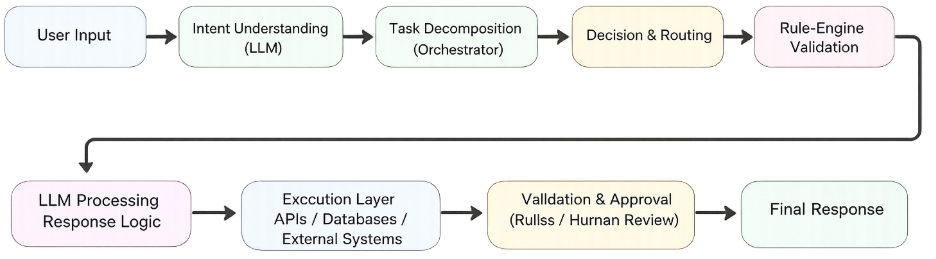
Scenario: A user submits a request:
“I want to check the status of my loan application and update my contact details.”
1. User Input (Perception Layer)
The system receives the user’s request through a chat interface.
2. Intent Understanding (LLM Reasoning)
The LLM analyzes the input and references previous customer interactions stored in memory to better understand context.
- Check loan application status
- Update contact details
3. Task Decomposition (Orchestrator)
The request is broken down into smaller tasks:
- Validate user identity
- Fetch loan status from database
- Update contact information
4. Decision & Routing
- Rule-based systems handle:
- Identity verification
- Validation rules (e.g., required fields)
- LLM handles:
- Understanding user intent
- Generating conversational responses
5. Execution (Action Layer)
- API call retrieves loan status
- Database is updated with new contact details
- Business rules ensure compliance, and high-risk actions can be routed for human approval when required.
The LLM composes a natural response:
“Your loan application is currently under review. Your contact details have been successfully updated.”
7. Validation & Delivery
Before updating customer details, the system may require identity verification and policy validation through predefined business rules. The final response is delivered to the user, while system logs and execution traces are captured for monitoring and auditing purposes.
Practical Enterprise Considerations
In enterprise environments, hybrid AI systems are rarely deployed as standalone chatbots. They are typically integrated with APIs, workflow automation platforms, databases, and monitoring systems to ensure controlled execution and traceability.
For example:
- Rule engines may enforce approval workflows
- Observability layers monitor AI decisions
- Guardrails validate outputs before execution
- Human approval may still be required for critical actions
This layered approach helps organizations balance automation with reliability and governance.
Challenges in Hybrid AI Development
While hybrid AI agents offer significant advantages, deploying them in enterprise environments introduces several challenges:
- Latency & performance: responses may take longer due to interactions across multiple components. This needs proper optimization
- Error Handling: If a component like an API fails, the system must handle it correctly. Otherwise, the AI might generate an incorrect or misleading response.
- Security & Data Privacy:
Sensitive enterprise data must be protected when interacting with LLMs, APIs, and external systems. - Guardrails & Validation:
AI-generated outputs require validation mechanisms to prevent hallucinations, unsafe actions, or policy violations.
Future of Hybrid AI Agents
The future of hybrid AI lies in building more specialized and adaptable systems. Emerging trends include domain-specific AI models for improved accuracy, integration of custom-trained models tailored to business needs, and enhanced predictive capabilities that enable systems to anticipate and resolve issues proactively.
As organizations continue to adopt intelligent automation, hybrid AI agents will play a critical role in creating scalable, reliable, and context-aware solutions.
Conclusion
Hybrid AI Agents aren't just a technical pattern; they're a practical answer to one of the hardest questions in enterprise AI: how do you build a system that's both intelligent and reliable?
Generative AI brings the flexibility to handle the messy, ambiguous, human side of business. Rule-based systems bring the precision to enforce the logic, compliance, and structure that enterprises depend on. Together, they form something neither can be alone: an AI system you can actually deploy with confidence.
As automation becomes table stakes, the differentiator won't be which organization uses AI; it'll be which ones build AI they can trust. Hybrid architecture is how you get there.
References
- Nasscom Community - https://community.nasscom.in/index.php/communities/ai/how-hybrid-ai-agent-development-works-architecture-workflows-use-cases
- BMC Blog – https://www.bmc.com/blogs/why-hybrid-ai-next-big-thing-mainframe-transformation/
- Sparkout- https://www.sparkouttech.com/hybrid-ai-agent/
- eGain- https://www.egain.com/blog/why-hybrid-ai-is-critical-for-enterprise-knowledge-management/