

Traditional Security Automation Agentic AI Introduction
Every minute, enterprise Security Operations Centers (SOCs) receive thousands of security alerts from firewalls, endpoint detection systems, cloud platforms, and identity services.
According to Osterman Research (cited by Dropzone AI), 90% of SOCs are overwhelmed by alert backlogs and false positives, leaving analysts feeling constantly behind- not due to lack of skill, but sheer volume.
As cyberattacks grow faster and more automated, traditional security operations that rely on manual investigation struggle to keep pace. This is where Agentic AI is transforming cybersecurity: unlike conventional AI systems that primarily generate insights, Agentic AI autonomously analyzes security events, reasons through complex scenarios, and executes response actions within established governance and security policies.
Rather than replacing cybersecurity professionals, Agentic AI acts as an intelligent security collaborator reducing alert fatigue, accelerating threat investigations, and enabling analysts to focus on high-impact incidents that require human judgment.
Why Agentic AI?
As attack surfaces expand and cyber threats grow more sophisticated, manual investigation alone can no longer keep pace. Gartner's 2024 research found that 40% of security operations leaders already identify AI as the single area with the most significant upcoming impact on their security operations.
Agentic AI addresses this challenge by introducing autonomous reasoning into security operations. Instead of simply following predefined rules, intelligent agents can investigate incidents, correlate information across multiple security systems, evaluate risk, and recommend or execute response actions while operating within organizational guardrails continuously adapting to changing situations and collaborating with security analysts to improve both response speed and decision-making.
In modern cybersecurity, speed is just as important as accuracy. Organizations that can identify, investigate, and respond to threats within minutes rather than hours are significantly better positioned to minimize business impact enabling a shift from reactive security operations to proactive threat detection and response.
Traditional Security Automation vs. Agentic AI
| Traditional Security Automation | Agentic AI |
| Executes predefined rules | Reasons before acting |
| Responds to alerts | Investigates incidents autonomously |
| Fixed workflows | Dynamic decision-making |
| Human-driven investigations | AI-assisted investigations |
| Reactive response | Proactive threat detection |
Architecture of an Agentic AI Security System
Unlike traditional security automation, an Agentic AI system consists of multiple intelligent layers that work together to detect, investigate, and respond to cyber threats. Rather than operating as isolated components, these layers continuously exchange information, enabling the system to make contextual decisions while maintaining governance, transparency, and human oversight.
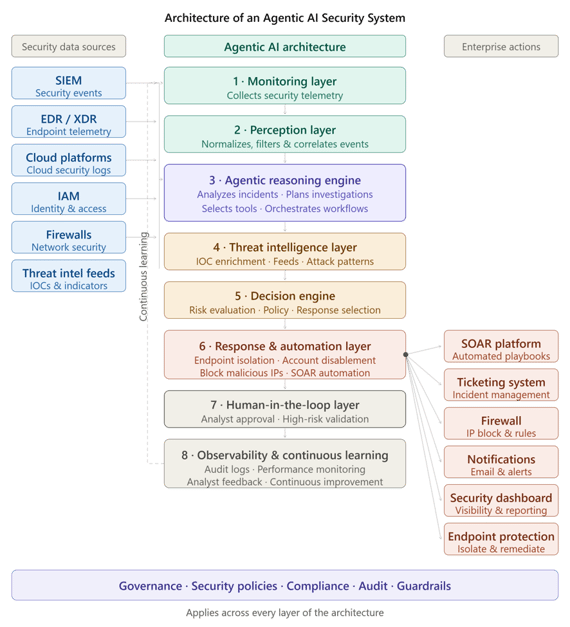
1. Monitoring Layer
Continuously collects security telemetry from enterprise systems such as SIEM, EDR/XDR, IAM, firewalls, cloud platforms, and network devices to identify potential security events.
2. Perception Layer
Processes and normalizes security data by filtering duplicate alerts, correlating related events, and building contextual understanding from multiple data sources.
3. Agentic Reasoning Engine
Acts as the orchestration layer of the system. It analyzes incidents, decomposes investigations into smaller tasks, selects the appropriate security tools, and determines the next best course of action.
4. Threat Intelligence Layer
Enriches investigations using indicators of compromise (IOCs), threat intelligence feeds, vulnerability databases, and historical incident data to improve threat assessment and reduce false positives.
5. Decision Engine
Evaluates investigation results against organizational policies, confidence scores, and risk levels to determine the most appropriate response strategy.
6. Response & Automation Layer
Executes approved actions through integrations with enterprise security platforms, such as isolating endpoints, disabling user accounts, blocking malicious IP addresses, or initiating SOAR playbooks.
7. Human-in-the-Loop Layer
Ensures that high-risk actions remain under analyst supervision by requiring human approval before executing critical response activities.
8. Observability & Continuous Learning Layer
Captures investigation logs, execution paths, and analyst feedback to support auditing, performance monitoring, compliance, and continuous improvement.
Together, these layers enable Agentic AI to move beyond simple alert processing and function as an intelligent security collaborator capable of detecting, investigating, and responding to cyber threats in real time.
How an Agentic AI System Responds: A Real-World Workflow
To understand how Agentic AI operates in cybersecurity, let's consider a real-world enterprise security scenario.
Scenario:
An employee successfully logs into the corporate network from Mumbai. Within a few minutes, another login attempt using the same credentials originates from a different country and attempts to access sensitive financial data.
Instead of simply generating another alert, the Agentic AI system begins an autonomous investigation.
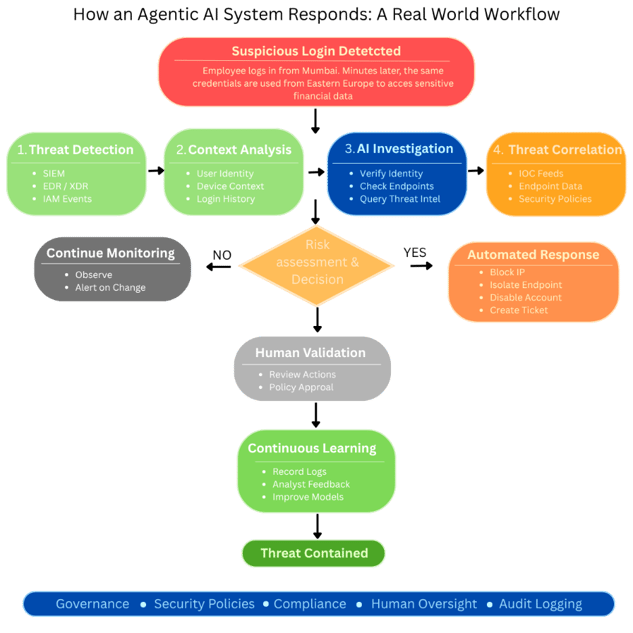
1. Threat Detection (Monitoring Layer)
The monitoring layer receives authentication logs, endpoint activity, network traffic, and cloud security events from multiple security platforms.
A suspicious login pattern is immediately detected.
2. Context Analysis (Perception Layer)
The AI agent gathers additional context by analyzing:
- Previous login history
- Device information
- User behavior
- Network location
- Cloud activity
Rather than evaluating a single alert, it builds a complete picture of the incident.
3. Autonomous Investigation (Agentic Reasoning)
The reasoning engine decomposes the investigation into multiple tasks:
- Verify user identity
- Check endpoint health
- Query threat intelligence
- Analyze lateral movement
- Review recent privileged activities
Instead of following a fixed workflow, the agent dynamically decides which investigation should happen next based on newly discovered evidence.
4. Threat Correlation & Decision
The system correlates:
- Threat intelligence feeds
- Known malicious IP addresses
- Identity information
- Endpoint telemetry
- Organizational security policies
Based on this evidence, the incident is classified as High Risk.
5. Automated Response
The response layer immediately executes predefined security actions such as:
- Blocking the malicious IP address
- Isolating the affected endpoint
- Temporarily disabling the compromised account
- Creating a high-priority incident ticket
These actions help contain the threat before it spreads further across the enterprise network.
The speed difference matters: agentic AI can move from detection to containment in under three minutes. A human analyst working through a backlogged queue may reach the same alert four to six hours later.
6. Human Validation
For critical actions, such as permanent account suspension or large-scale containment, the incident is escalated to a security analyst for review.
This ensures that human expertise remains part of the decision-making process.
7. Continuous Learning
After the incident is resolved, investigation data, response actions, and analyst feedback are recorded to improve future detections and optimize response strategies.
This workflow demonstrates how Agentic AI combines contextual reasoning, threat intelligence, automation, and human oversight to accelerate incident response while maintaining governance and operational control.
Practical Enterprise Considerations
Agentic AI delivers the greatest value when integrated into an organization's existing cybersecurity ecosystem rather than operating as a standalone solution. Instead of replacing existing security tools, it acts as an intelligent orchestration layer that connects data sources, automates investigations, and coordinates response actions across the enterprise.
Some key integrations include:
- SIEM (Security Information and Event Management): Aggregates and centralizes security events, enabling Agentic AI to detect suspicious patterns and initiate investigations.
- EDR/XDR (Endpoint Detection and Response / Extended Detection and Response): Provides endpoint telemetry that helps identify malicious behavior, isolate compromised devices, and contain threats.
- Threat Intelligence Platforms: Enrich investigations with Indicators of Compromise (IOCs), malicious IP addresses, attack techniques, and vulnerability intelligence to improve decision-making.
- Identity and Access Management (IAM): Validates user identities, monitors authentication activities, and detects anomalies such as impossible travel, privilege escalation, or credential misuse.
- SOAR (Security Orchestration, Automation, and Response): Executes approved response actions automatically while maintaining organizational security policies and governance.
- Ticketing & Incident Management Systems: Record investigations, decisions, and response actions to support collaboration, auditing, and compliance.
By integrating with these platforms, Agentic AI enhances existing security operations rather than replacing them, enabling organizations to respond faster while maintaining visibility and operational control.
Challenges in Implementing Agentic AI
While Agentic AI has the potential to transform cybersecurity operations, deploying autonomous security systems introduces several challenges that organizations must carefully address.
Trust & Explainability:
Security analysts must understand why an AI agent reached a particular decision. Explainable reasoning and transparent investigation paths are essential for building confidence in autonomous systems.
Human Oversight:
Not every security action should be fully autonomous. High-impact decisions, such as disabling privileged accounts or initiating large-scale containment, should remain subject to human approval.
Security of AI Agents:
As AI agents become part of the security infrastructure, they themselves become potential attack targets. Organizations must secure agent identities, permissions, APIs, and communication channels against unauthorized access.
Prompt Injection & Adversarial Attacks:
Attackers may attempt to manipulate AI agents through malicious prompts, poisoned data, or adversarial inputs. Strong guardrails, input validation, and policy enforcement are essential to maintain trustworthy decision-making.
Data Privacy & Regulatory Compliance:
Agentic AI processes sensitive enterprise logs, user identities, and business data. Organizations must ensure compliance with regulatory requirements while protecting confidential information.
Integration Complexity:
Large enterprises often rely on diverse security tools and legacy infrastructure. Successfully integrating Agentic AI across these platforms requires careful planning, governance, and interoperability.
Future of Agentic AI in Cybersecurity
As cyber threats continue to evolve, security operations are expected to become increasingly autonomous. Future advancements will enable AI agents to collaborate across multiple security domains, proactively hunt emerging threats, and coordinate response actions with minimal human intervention. Industry analysts project that agentic AI adoption in enterprise SOCs will grow significantly through 2028, driven by the pressure to reduce mean time to respond (MTTR) at scale.
Organizations are also moving toward multi-agent security ecosystems, where specialized AI agents work together to monitor networks, analyze threats, manage identities, investigate incidents, and automate remediation. This collaborative approach enables faster, more intelligent decision-making while reducing the burden on security teams.
Combined with predictive analytics, adaptive learning, and stronger governance frameworks, Agentic AI will help organizations shift from reactive incident response to proactive cyber resilience.
Conclusion
Agentic AI represents a significant evolution in cybersecurity, moving beyond rule-based automation to intelligent systems capable of investigating threats, reasoning through complex scenarios, and executing response actions within established governance frameworks.
However, successful adoption depends on more than deploying advanced AI models. Organizations must combine intelligent automation with robust security controls, explainable decision-making, and human oversight to ensure that autonomous systems remain trustworthy, secure, and accountable.
The future of cybersecurity will not be defined by AI replacing security professionals, but by intelligent collaboration between autonomous agents and human expertise. Organizations that embrace Agentic AI today won't simply automate security operations, they'll redefine how modern cyber defense is built.
References
- Dropzone AI- What is Agentic AI? Exploring Its Role in Security Operations
- Gurucul - What is Agentic AI in Cybersecurity?
- Red Canary - Agentic AI in Security Operations
- miniOrange - Agentic AI in Cybersecurity
- AImultiple - Agentic AI in Cybersecurity
- Rapid7 - Agentic AI Fundamentals