

Across this “Teaching AI to Speak FDA: The New Language of Clinical Data”, we have followed clinical trial data on its complete journey - from the moment it is first collected from a study participant to the day it lands in front of a healthcare authority reviewer as part of a regulatory submission. Along the way, we introduced the core CDISC standards that keep that data consistent, understandable, traceable, and ready for submission.
The journey began with a simple but persistent problem. Clinical trials generate enormous volumes of data, and without a shared set of rules, that data becomes difficult to interpret. Different organizations collect information in different ways, use different variable names, and structure their datasets according to their own conventions. Even when the underlying science is sound, inconsistencies in how data is presented can slow down regulatory review and increase the chance of misunderstanding. This is exactly the problem that CDISC, the Clinical Data Interchange Standards Consortium, was created to solve.
Today, CDISC standards sit at the foundation of modern clinical research submissions around the world. Regulatory bodies such as the U.S. Food and Drug Administration, the European Medicines Agency, and Japan's Pharmaceuticals and Medical Devices Agency all expect sponsors to submit clinical data in standardized formats that allow for efficient review and analysis. This final piece brings everything together, examining how CDASH, SDTM, ADaM, Define-XML, the SDRG, and the ADRG function as a single connected ecosystem, and exploring how automation and AI are reshaping the way that ecosystem operates.
The Complete CDISC Data Tour
Every successful submission follows a structured path: it begins with collecting data from participants and ends with regulators weighing evidence to decide whether a treatment is safe and effective. Each CDISC standard has a specific, well-defined role somewhere along that path.
Step 1 - CDASH: Standardized Data Collection
Clinical research starts with collection of demographics, medical history, lab results, vital signs, adverse events, concomitant medications, and efficacy assessments. CDASH (Clinical Data Acquisition Standards Harmonization) standardizes the structure and terminology of the case report forms used to capture this data. Its goal is simple: collect it correctly the first time.
Studies that follow CDASH from the outset enter the ecosystem with less ambiguity, which lightens downstream data cleaning and prevents the costly problems that poor collection practices tend to create later.
Step 2 - SDTM: Organizing Data for Regulatory Review
Once collected, data must be reshaped into a format regulators can navigate without friction. SDTM (Study Data Tabulation Model) does this by organizing raw data into standardized domains like Demographics, Adverse Events, Concomitant Medications, etc., so reviewers recognize the structure on sight rather than learning each sponsor's own layout.
SDTM acts as a translation layer into a universal format, enabling faster review, easier navigation, more consistency across studies, and better interoperability freeing reviewers to focus on the science rather than the dataset architecture.
Step 3 - ADaM: Transforming Data into Evidence
SDTM organizes data but was never meant to drive statistical analysis directly. That role belongs to ADaM (Analysis Data Model), whose datasets are built from SDTM to support the statistical analyses, tables, listings, figures, and clinical study reports behind a treatment's safety and efficacy case.
Traceability sits at ADaM's core: every derived value should trace back to its SDTM source, letting a reviewer answer how an endpoint was calculated, who was included in the analysis population, how missing values were handled, and what derivation rules applied.
Step 4 - Define-XML: Explaining the Data
Even well-structured datasets need documentation. Reviewers need to know what each variable represents, how datasets relate, which controlled terminology applies, and how derived variables were calculated. Define-XML is the metadata guidebook for the submission describing dataset structures, variable definitions, controlled terminology, algorithms, value-level metadata, and dataset relationships, so regulators are never left interpreting unfamiliar data manually
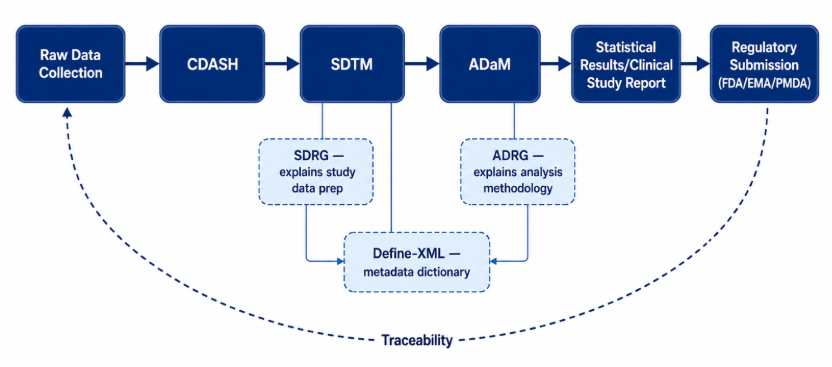
Fig. Clinical Trial Data Flow: From Data Collection to Regulatory Submission
Why Traceability Matters
Traceability is one of the most important ideas in the entire regulatory submission process. Regulators need to be able to follow a clear path from raw data, through SDTM, into ADaM, and finally to the statistical results that are reported. If a reviewer encounters a treatment effect described in a study report, they should be able to trace that result all the way back to the analysis dataset that produced it, the SDTM source records behind that dataset, and the original observations collected from participants.
This level of transparency is what builds confidence in a study's conclusions. Without it, results become difficult to verify; reviews take longer, regulatory questions multiply, and the overall risk to the submission grows. CDISC standards are built specifically to support this kind of end-to-end traceability, which is part of why they have become so central to the submission process.
The Rise of Automation in Clinical Data Standards
Historically, building a submission package demanded an enormous amount of manual effort. Teams would spend thousands of hours mapping variables, building SDTM and ADaM datasets by hand, writing metadata, producing reviewer guides, and running validation checks one step at a time.
That landscape is changing. Modern platforms now leverage rule-based automation to automatically validate CDASH-compliant forms, generate SDTM mappings, build ADaM datasets, produce Define-XML metadata, run compliance checks, and generate submission documentation with greater speed and consistency.
The benefits of this shift are tangible: less human error, shorter development timelines, lighter validation effort, and lower operational costs overall. As regulatory requirements continue to grow more complex, these automated solutions are only becoming more valuable to sponsors trying to keep pace.
The Emerging Role of Artificial Intelligence
Artificial intelligence is beginning to touch every stage of the CDISC workflow. During data collection, AI can flag missing values, inconsistent entries, and protocol deviations as they happen rather than after the fact. In the SDTM mapping stage, machine learning models can recommend domain assignments and variable mappings automatically, cutting down manual review. AI can also help generate Define-XML descriptions and metadata documentation directly from dataset structures.
Beyond individual tasks, AI systems are increasingly able to monitor datasets continuously for CDISC compliance issues, and future platforms may be able to evaluate an entire submission package at once, surfacing gaps before it ever reaches a regulator. None of these are intended to replace clinical data professionals. Instead, AI is best understood as a powerful assistant, one that takes over repetitive manual work so that experts can spend more of their time on the scientific and regulatory judgment calls that require a human perspective.
Conclusion
Clinical research is steadily moving toward a more connected, intelligent, and automated data ecosystem. In the years ahead, it is reasonable to expect AI-assisted study design, near real-time SDTM generation, automated metadata creation, continuous compliance monitoring, more intelligent traceability systems, faster regulatory submissions, and clinical development programs that run more efficiently overall. Organizations that embrace both standards and automation early will be better positioned to deliver high-quality submissions faster and with greater confidence than those that do not.
Clinical trials generate evidence that can change lives, but that evidence is only as useful as it is understandable, reviewable, and trustworthy. That is the underlying reason CDISC standards matter so much - these standards form a complete framework for regulatory submissions, one built on transparency, traceability, and compliance. As automation and artificial intelligence continue to mature, clinical data management will keep becoming more efficient, more intelligent, and more connected. Even so, the fundamental goal will not change, giving regulators the confidence to evaluate clinical evidence properly and make informed decisions that, ultimately, benefit patients everywhere.
This brings our CDISC blog series to a close, from the original language problem in clinical trials to this look ahead at a standardized, AI-enabled future for regulatory submissions. The journey clinical data takes is undeniably complex, but with the right standards in place, it becomes a language that everyone involved can understand.